

Sawtooth/Ramp Generation — Linear Ramp Waveform Output
Advanced Pulse Features
What it is
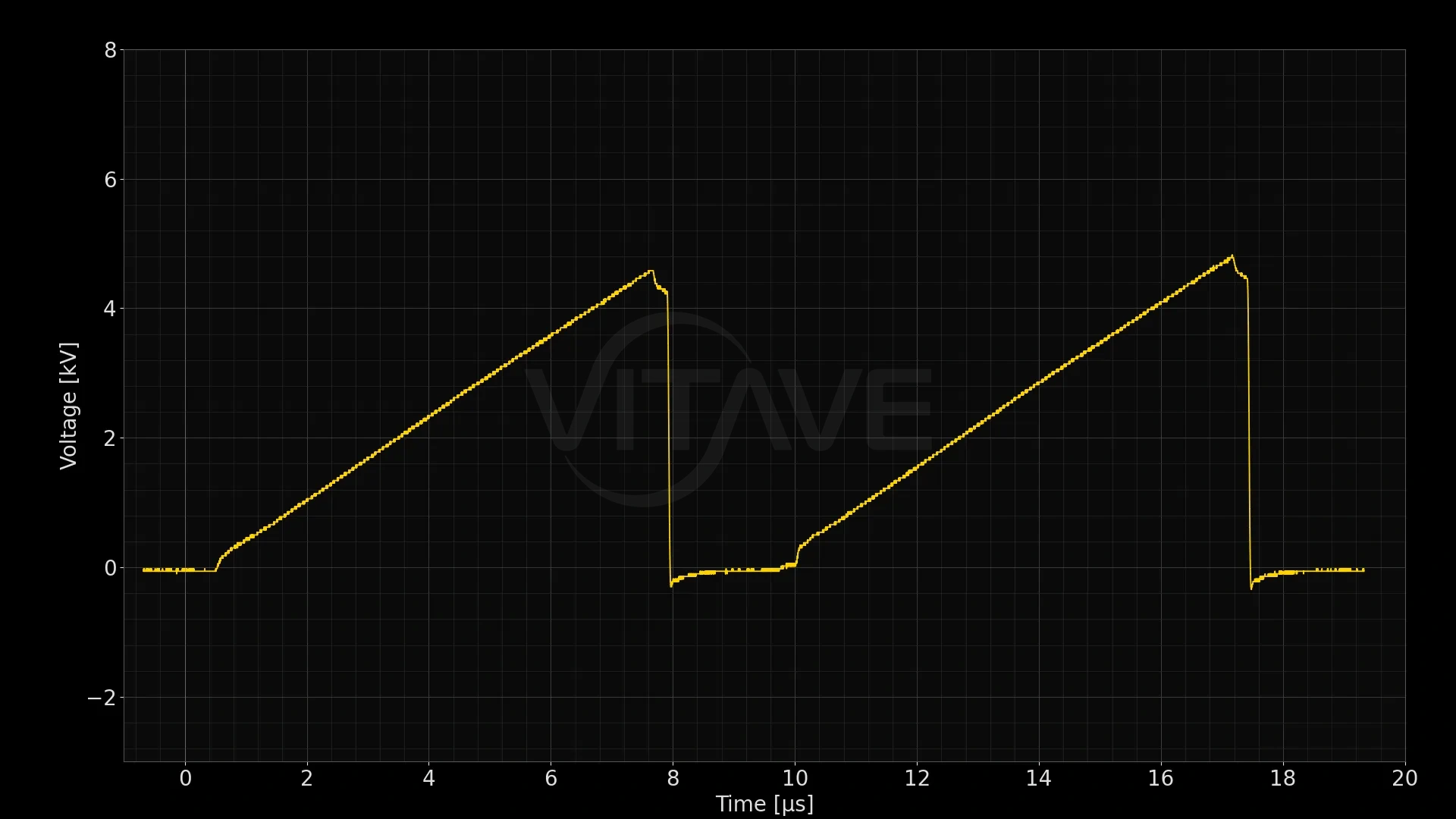
Most pulse generators produce rectangular waveforms: the output steps up, holds, and steps down. Sawtooth/Ramp Generation produces a different waveform shape: a linear voltage ramp during the charge phase, followed by a fast collapse on discharge — a sawtooth. The charge phase is driven by a programmable constant current source; the discharge is via a solid-state fast switch.
Because a constant current charges a capacitive load at a rate set by I/C, the voltage across the load rises linearly during the charge phase. The fast-discharge switch then collapses the voltage rapidly. The result is a clean sawtooth: controlled linear rise, sharp fall. Available in both positive and negative polarity.
Why it matters
If your application depends on charging a capacitive load to a specific voltage over a controlled, predictable duration — rather than however fast a passive RC circuit happens to settle — you need direct control over the charge rate itself, not just the target voltage. A programmable constant-current source gives you that control: the same target voltage can be reached faster or slower depending on the current level you set, independent of the load's own natural time constant.
Technical detail
The charge-phase current is directly programmable, and for a capacitive load this sets the charge time explicitly: for capacitance C, current I, and target voltage V, the time to reach V is t = C·V/I. Raising the current shortens the charge phase for the same target voltage; lowering it extends it — this is the direct mechanism behind the controllable charging time.
The discharge phase uses a solid-state switch rather than a passive RC decay. This keeps the fall fast and largely decoupled from the charge-phase time constant, so the cycle can repeat at a defined rate without the discharge dragging out the period.
Positive and negative polarity ramps are both available, so the waveform can alternate direction cycle-to-cycle or run bipolar sequences as needed.
See also