

OmniPorator MATRIX — Programmable Matrix Electroporation Pulse Generator
Overview
The OmniPorator MATRIX scales from 40 to 100 channels — but the defining difference from the MULTI is not channel count. It is output topology.
In a MULTI, each channel is a self-contained HV+ground pair. In a MATRIX, each channel has a single output pin — software-programmable as ground, HV, or floating. There are no fixed partners. This means the field topology is dynamically reconfigurable: any pin can drive, any pin can be the return path, any pin can sit out.
MULTI and MATRIX serve fundamentally different purposes, not just different scales. MULTI gives you independent bipolar channels — throughput for parallel samples. MATRIX gives you spatial control within the treatment area through programmable electrode assignment, for patterns a fixed set of channel pairs can't cover.
MATRIX runs on Bridge output throughout, every pin driven differentially, at up to 2.5/4 kV. Bridge splits the voltage across two electrodes instead of one, which is what keeps the per-pin hardware cost-effective as channel count climbs into the hundreds.
For large-scale electroporation research, multi-electrode arrays, or any application that requires independently addressable electrode points, the MATRIX is the right starting point for a conversation.
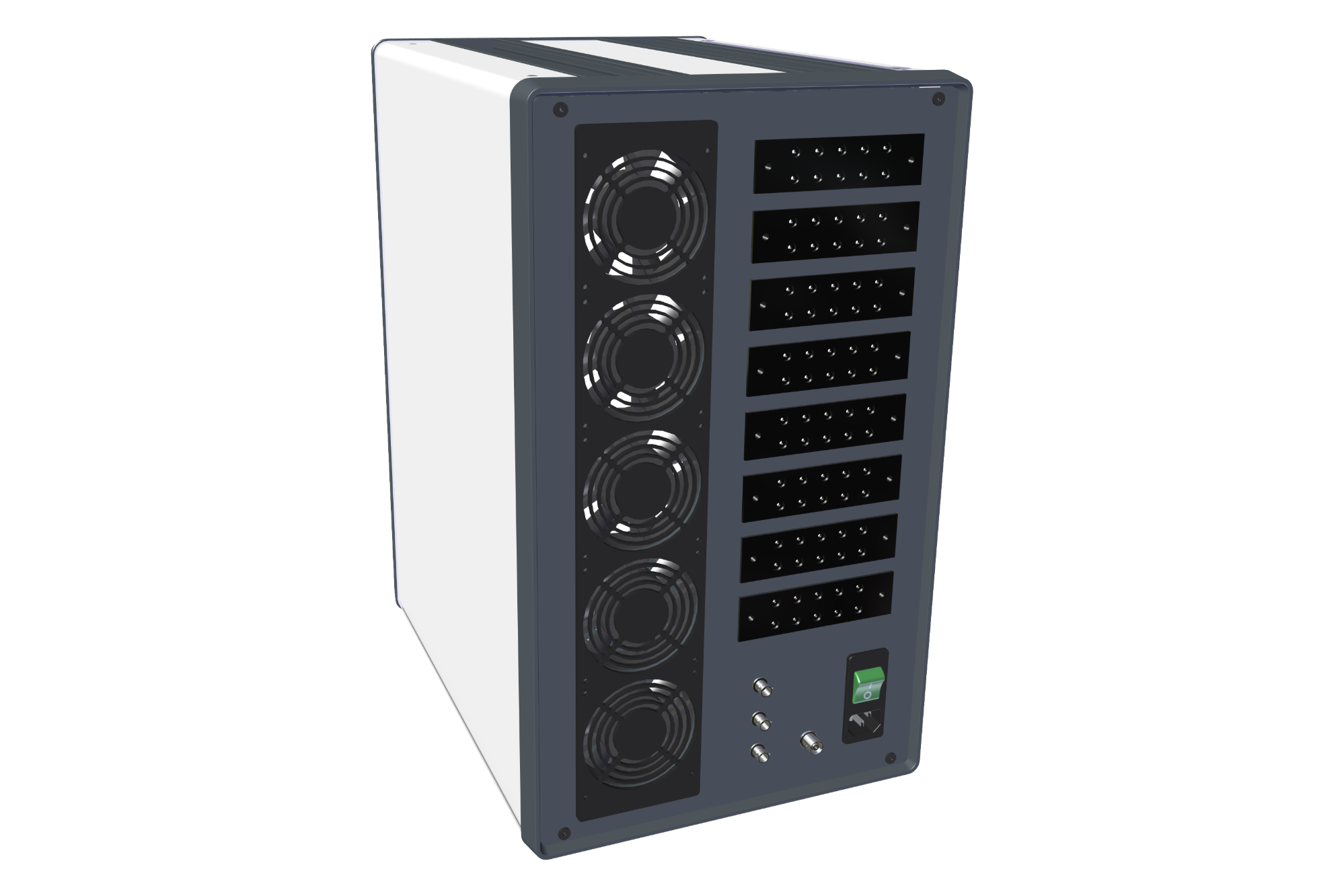

Standard configurations
| Parameter | Options |
|---|---|
| Channels | 40 / 60 / 80 / 100 |
| Peak Voltage | 2.5 / 4 kV |
| Peak Current | 50 A |
| PSU Power | 500 W |
Configurability and options
The matrix control architecture is the defining capability — each point in the array independently set to positive, negative, or floating within the same pulse sequence. Beyond that, Remote API Control is particularly relevant at this scale: programming a large matrix by hand is not practical, and the API enables the automated control and reproducible protocols that electrode array work requires.
External Trigger Input and Output are available for synchronisation with imaging systems, measurement equipment, or secondary processes.
See also
Application areas
Working with large-scale electrode arrays or high-channel-count electroporation?
Get in touch