

Burst Mode — Grouped Pulses per Period
Core Pulse Technology
What it is
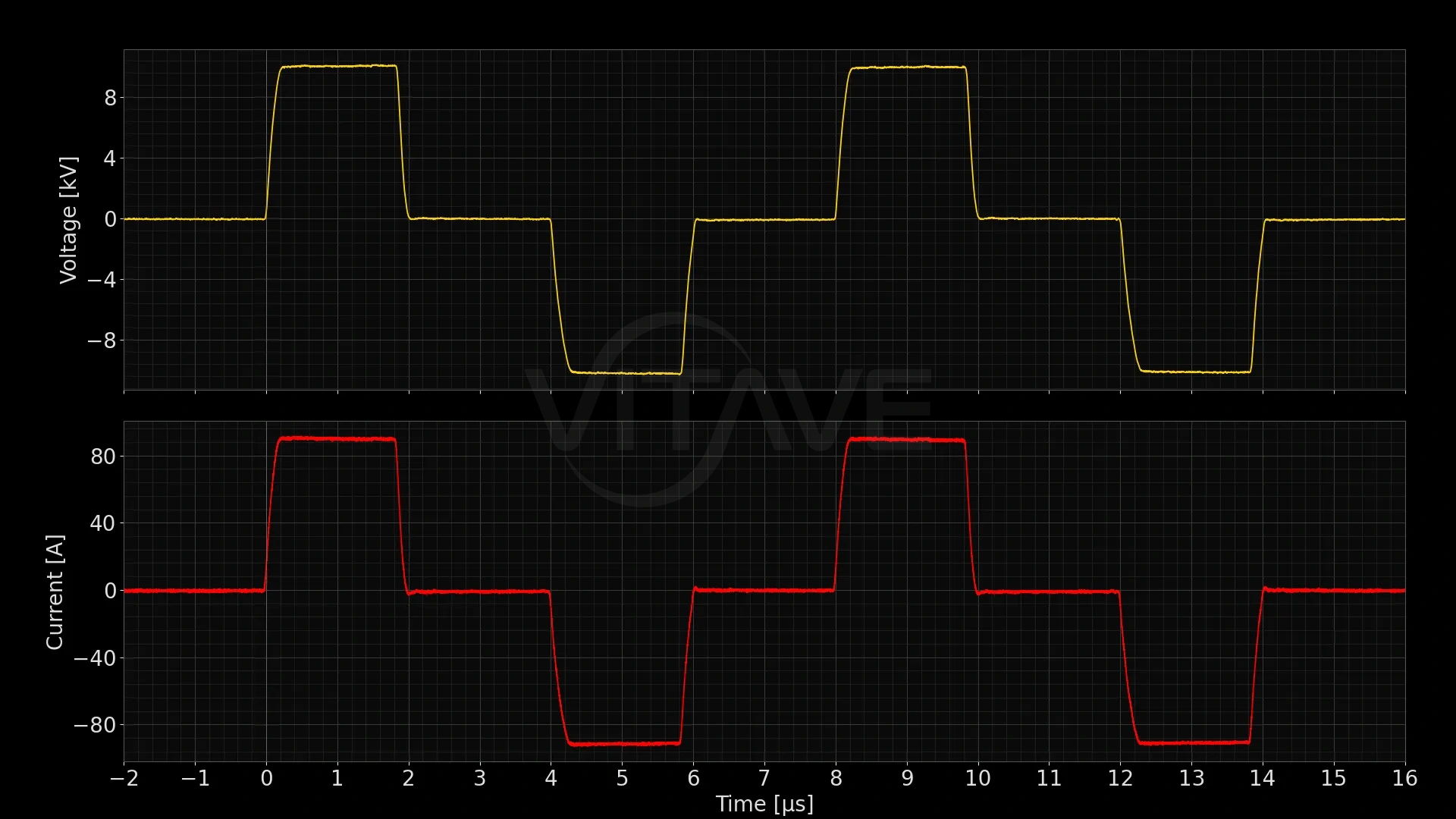
Burst Mode allows the user to apply a high number of pulses, one after another, at the beginning of each period — this group of pulses is the burst (pulse train). Between bursts, the output pauses for a defined inter-burst delay before the next one begins.
Four parameters define the structure independently: the number of pulses per burst, the inter-pulse delay within the burst, the burst repetition rate, and the inter-burst delay. These are set separately, not derived from each other. The intra-burst frequency can be substantially higher than the generator's continuous duty rating. In many applications, though, the burst structure itself is what produces the desired effect.

Why it matters
Burst Mode exists because customers kept asking for it — often after finding, through their own trials or published work, that a specific burst structure improved their results, without necessarily being able to explain why. That's reason enough on its own: the capability doesn't need a mechanism explanation to be worth having.
What we control precisely is the structure itself — pulse count, the spacing within the burst, and the timing between bursts, each independently adjustable. Matching that structure to the effect you're after is where your own experience with the process comes in.
Technical detail
The inter-pulse delay within a burst is set independently of the burst repetition rate. This means the intra-burst frequency can exceed what the generator can sustain continuously — burst duty cycle, not intra-burst frequency, determines the average power. For applications that need a high instantaneous pulse rate but a manageable average power, this is the relevant parameter pair to optimise.
The inter-burst delay is a first-class parameter, not a derived quantity — it can be set to whatever value the application requires, rather than fixed to some ratio of the burst duration. The right value depends entirely on the specific application, which is exactly why the generator needs to leave it freely adjustable rather than assuming it.
Burst Mode combines directly with Arbitrary Sequencing. A sequence can contain bursts with different parameters — a higher-energy ignition burst followed by lower-energy sustain bursts, or a sequence where burst parameters change at defined points in the protocol. Which structure is appropriate is dictated entirely by the application.
See also