

Arbitrary Sequencing — Custom Pulse Trains
Core Pulse Technology
What it is
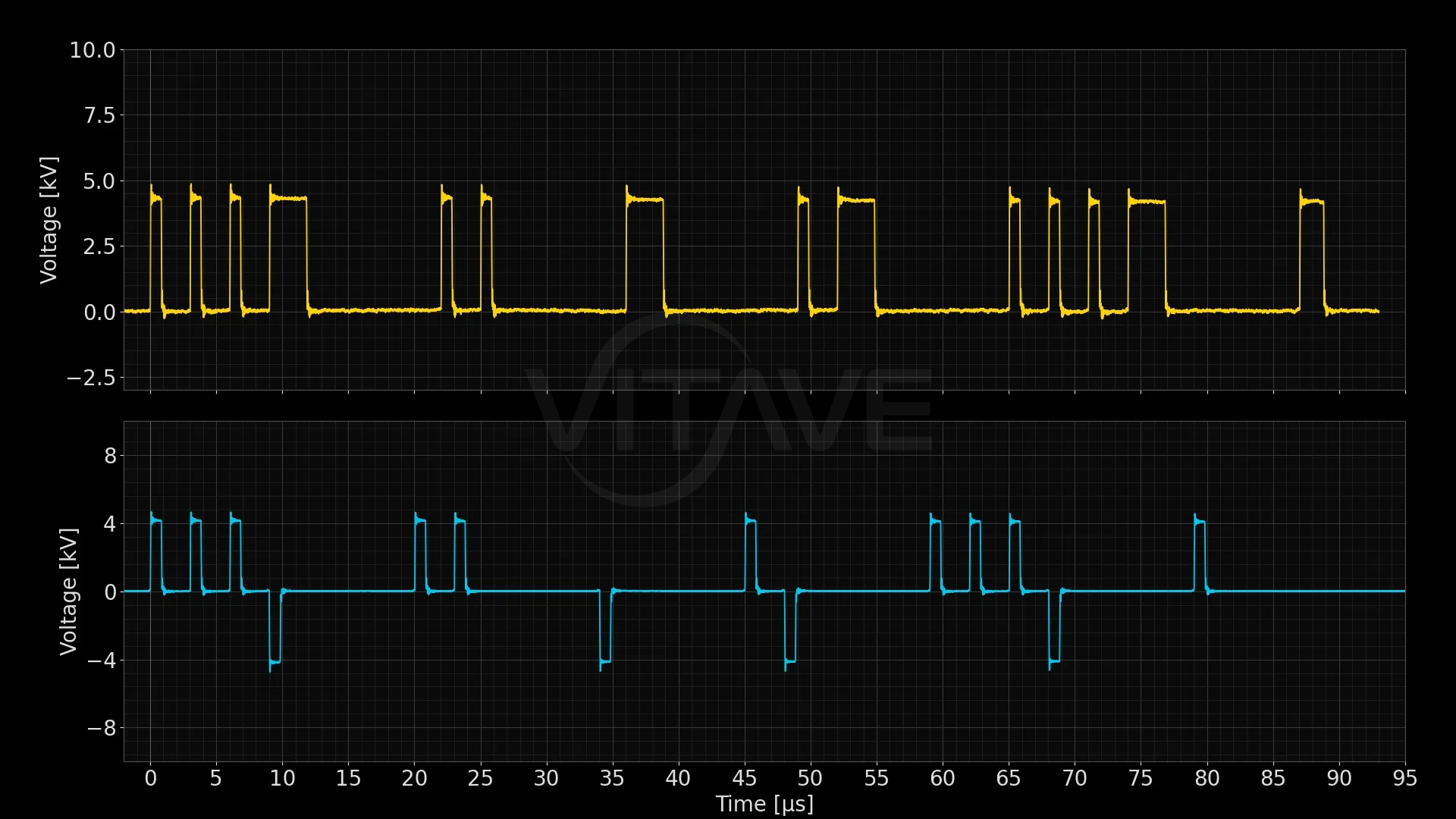
A standard pulse generator fires one pulse shape on repeat: fixed duration, fixed polarity, fixed repetition rate. Arbitrary sequencing removes that constraint — each step in the sequence has its own duration, polarity, and delay to the next step, and the hardware executes that timing exactly as programmed.
That includes the simple case: if all you need is one pulse shape repeated at a fixed rate, arbitrary sequencing does that too — it's just a sequence with one step repeating. But it's equally capable of far more elaborate patterns: steps with different durations, alternating or mixed polarities, uneven spacing between events, sequences that run once, loop continuously, or trigger on an external input. The only real limit is the timing resolution and the number of programmable steps — not any built-in assumption about what a pulse train should look like.
Why it matters
Your research shouldn't be limited by what your pulse generator can produce. If your protocol calls for pulses of different durations, alternating polarities, or spacing that changes partway through, a fixed-repetition generator forces you to simplify the protocol to fit the hardware — or work around it with manual re-triggering and extra equipment. Arbitrary sequencing removes that limit: you design the sequence your research actually calls for, and the generator executes it exactly as specified, not an approximation of it.
Most real applications do not use a single repeated identical pulse. They use protocols — sequences where the timing, polarity, and order of pulses are varied deliberately because the biology, physics, or process responds differently at different points in the sequence.
Technical detail
Each step in a sequence specifies: polarity, duration, and delay to the next step. Steps execute in order. The minimum inter-step interval, timing resolution, and maximum number of steps determine the range of protocols that can be expressed.
This isn’t a standalone capability — arbitrary sequencing is designed to combine with the rest of the platform, from external synchronization to per-step behavior driven by other configured capabilities.
External trigger input synchronises sequence execution to an external reference — the machine clock in an accelerator, the camera exposure trigger in an imaging experiment, the data acquisition arm signal in a research setup. The sequence starts on the trigger edge; subsequent steps execute on their programmed delays relative to that moment. Trigger jitter in the generator is what limits synchronisation precision, and it is specified explicitly rather than left as an implied performance characteristic.
In constant current mode, each step maintains its own current target independently, regardless of load impedance at that point in the sequence. In multi-channel systems, sequences on different channels can be offset in time relative to each other, which is how phased multi-electrode protocols are implemented.
See also