

Pulsed power that fits your application – not the other way around.
High-voltage generators for medicine, food processing, plasma research, particle accelerators, and anything else that needs a precisely shaped pulse.
VITAVE doesn't start with a product catalog. We start with your problem. Tell us what you're trying to do — voltage, pulse shape, repetition rate, the constraints that matter — and we'll configure the right system together.
Let's Talk- #1
- 10
- 100
- 1,000
- 10,000
- 100,000
- 1,000,000
We speak your field's language first.
High-voltage pulsing shows up differently across disciplines. Here's where it fits into the problems you're already working on.
-
Medicine & Life Sciences
Irreversible electroporation, electrochemotherapy — every one of these depends on hitting the target with precision and leaving what's around it alone. That's a pulse-delivery problem before it's anything else.
-
Food Processing
Extraction, pasteurisation, seed treatment — pulsed electric fields solve three problems that look unrelated but come down to the same thing: the same physical effect at different energy levels. Scaling from lab validation to continuous industrial throughput means solving very different engineering problems along the way.
-
Plasma Generation
From cold atmospheric plasma jets to kiloamp-range discharge experiments, the operating range is enormous — but in every case, the line between a useful discharge and a destructive arc is thinner than it looks, and it comes down to how the pulse is delivered.
-
Component Testing
Standard dielectric tests miss what actually breaks components in service — repetitive fast-rising transients, partial discharge that erodes insulation pulse by pulse. It's most visible in EV traction systems, where voltages are climbing past 800 V and switching frequencies into the hundreds of kHz.
The technical depth to handle the edge cases.
Standard pulse generators handle standard problems. These are the capabilities that matter when your application isn't standard.
-
Arbitrary Sequencing
Program pulse duration, polarity, and the gaps between pulses as a single sequence — not a fixed shape repeated on a timer. The generator executes exactly what's programmed.
A generator that only fires one shape on repeat forces you to simplify your protocol to fit the hardware, or bolt on manual re-triggering to work around it. Most real protocols vary timing, polarity, and order deliberately — because the result depends on more than a single fixed waveform.
-
Multi-Frequency Impedance Measurement
Measures a load's impedance across a frequency range, through the same treatment electrodes, between pulses.
The usual alternative is an external LCR meter — disconnecting the load for every reading, since the generator's own idle output circuitry would otherwise distort the measurement. Built-in measurement skips that: no separate instrument to connect, disconnect, or insulate against pulse voltage.
-
Constant Current Operation
The generator holds the set current fixed and lets voltage be the passive result — voltage = current × load impedance — instead of setting voltage and letting current follow whatever the load does.
A voltage source lets current follow the load — if impedance shifts, so does the current, and so does the delivered energy. Fixing the current instead makes the set value an absolute ceiling the load can never push past, pulse after pulse.
-
Adjustable Overcurrent Protection
A software-set current ceiling below the hardware limit — a higher-rated system dialed down to behave like a lower-rated one.
If a component, applicator, or fixture in your setup is rated for less current than the generator can deliver, running at full capability risks damaging that part of the setup — not the generator. Dial in a lower ceiling for that setup, then restore full capability with one click once you're done.
Four product lines. One configurable platform.
Each line covers a region of the capability space. The boundaries are soft — most systems ship with modifications that don't fit neatly into any single category.
-
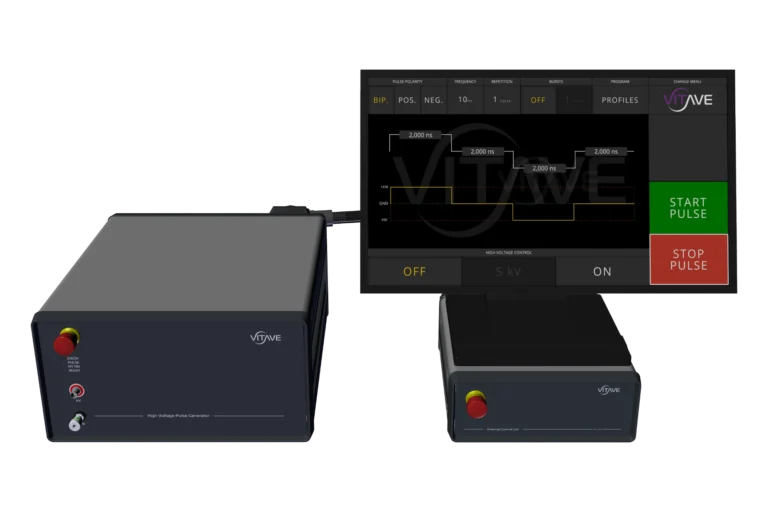
OmniPorator
VITAVE's electroporation platform.
A single channel covers most electroporation work. When the target is too large for one electrode pair, or the field itself needs to be shaped rather than fixed, the platform scales into multi-channel and matrix configurations without changing systems.
-
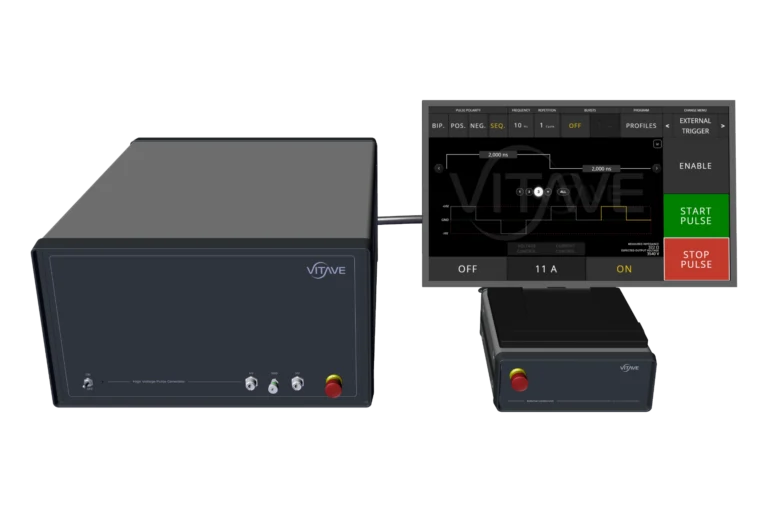
OmniPulser
VITAVE's pulsed power platform.
GP is the general-purpose variant. HF adds sustained operation at high continuous frequency. Together, they make this a versatile platform, capable of serving very different kinds of applications without changing systems.
-
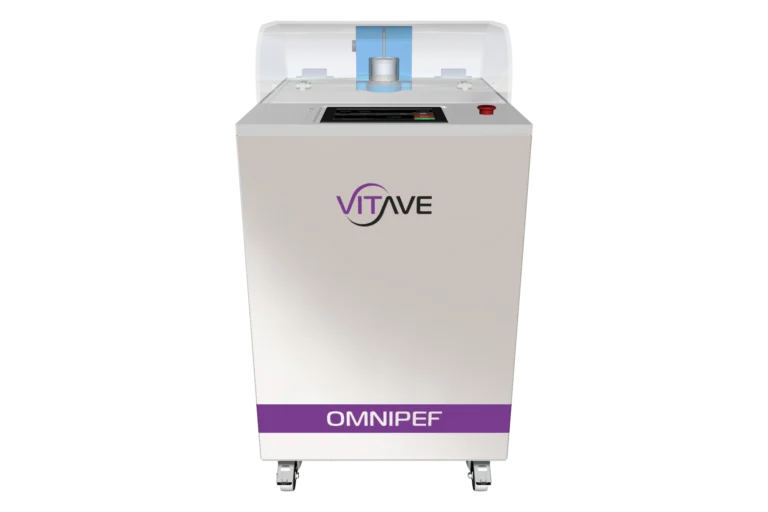
OmniPEF
VITAVE's PEF platform.
BENCH and LAB cover process development, from a benchtop starting point to an integrated, transportable system. INDUSTRIAL is built for production — always configured individually around the actual process.
-

Accessories
VITAVE's accessory hardware.
Pumps, treatment chambers, safety covers, and signal converters — handy accessories that help you focus on research instead of setup.
Your application is probably not standard.
That's fine — most of the interesting problems aren't. The right pulse generator for your work depends on details that only come out in conversation. Start there.