

Adjustable Rise Times — Software-Selectable Pulse Edge
Advanced Pulse Features
What it is
Some applications need the pulse edge as fast as physically possible. Others need it slower, deliberately. And in some cases, the same process or experiment produces different results depending on exactly how fast that edge arrives — rise time isn't just a waveform detail, it's a variable that changes the outcome.
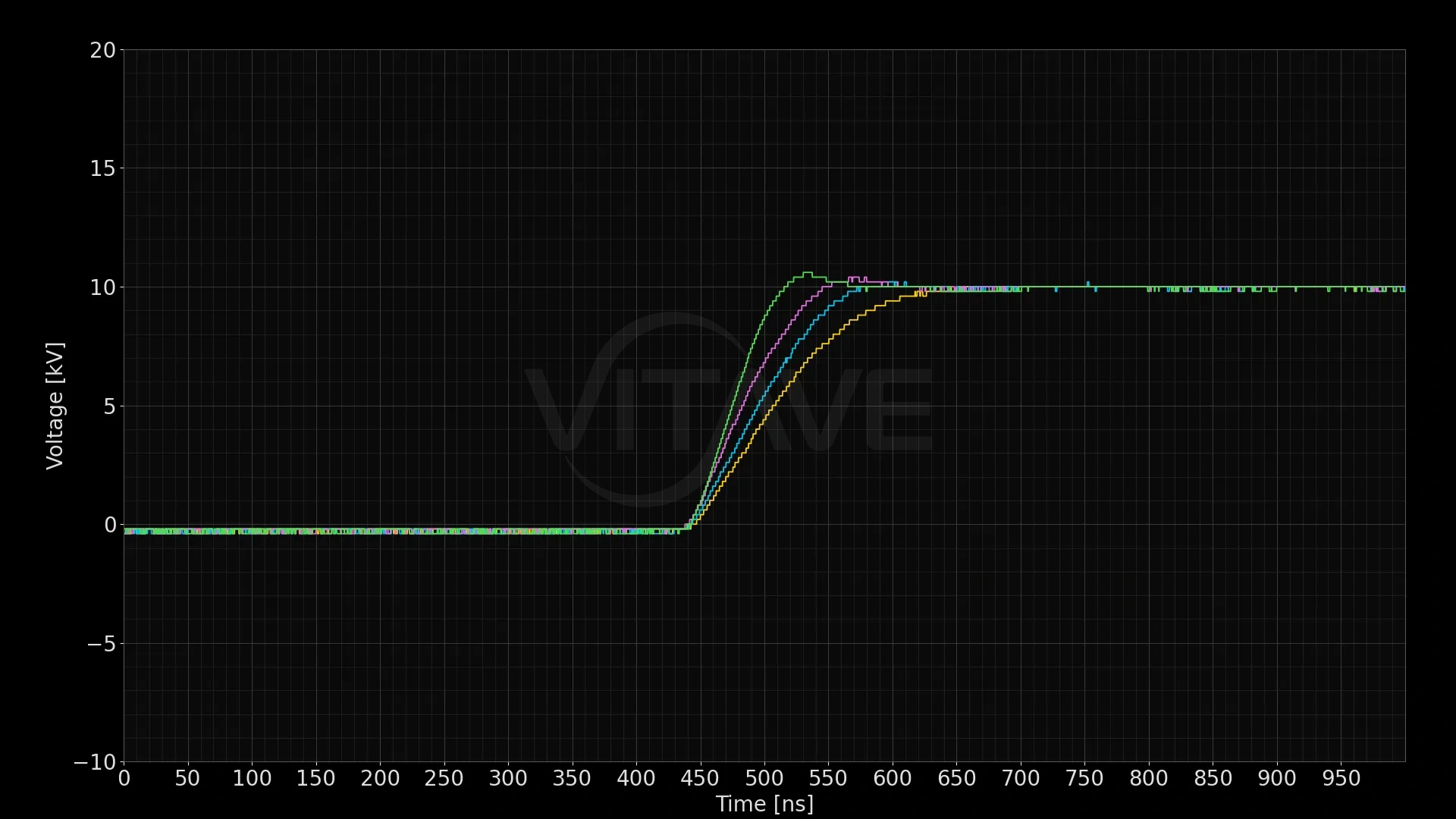
Adjustable Rise Time gives you that control at a broad level: the edge can be made faster or slower to fit what the application needs, rather than locked to whatever value the hardware happens to produce by default.
Why it matters
If your process depends on the pulse edge arriving at a specific speed, a fixed rise time is a real constraint — not a footnote. You either accept the number stamped on the datasheet or redesign your setup around it, even when the edge speed itself is the thing that determines whether the process works the way you need it to.
Adjustable Rise Time removes that constraint. Whether your application needs the fastest edge physically achievable, a deliberately slower one, or something in between to see how the result changes with it, that's a setting — not a hardware limitation you have to design around.
Technical detail
Rise time is set by how the output stage’s switching devices are driven. A faster drive signal switches the transistors more abruptly, producing a faster edge; a slower drive signal spreads the transition out. The achievable range has real limits at both ends — the switching devices and output circuit only go so fast, and slowing the drive too far starts to interact with the rest of the pulse shape.
See also